Imvent
Designing the operational backbone for Dubai's premium content studio from creator booking to real-time studio management.
Designing the operational backbone for Dubai's premium content studio from creator booking to real-time studio management.
Designing the operational backbone for Dubai's premium content studio from creator booking to real-time studio management.
Challenge
A Premium Studio Running on Informal Systems
Imvent Studios had a scaling problem. Not a growth problem — an operational one. With 8 studios running back-to-back sessions throughout the day, the margin for miscommunication was zero. But the system holding it all together was a patchwork of group chats, verbal confirmations, and manual cross-checking.
The client came with documented evidence, not assumptions:
Creators were arriving to sessions that weren't set up correctly — lighting, camera configuration, seating, and equipment preferences were communicated over WhatsApp hours or days before the shoot, then lost, misread, or forgotten by the time the operator opened the studio.
Refund requests were piling up around add-on services. Editing packages, extra operator time, and specialty equipment weren't visible during the booking flow — they surfaced after confirmation, when creators felt blindsided by the added cost.
Equipment and scheduling conflicts between back-to-back sessions had no early warning system. Managers were catching overlaps on the day, not the week before.
Agencies managing multiple creators had no consolidated view of their roster. Every creator was a separate thread, a separate booking, a separate conversation.
The pattern across every failure was the same: each role was operating with a different, incomplete version of the same session. Creators didn't know what operators expected. Operators didn't know what creators wanted. Managers couldn't see any of it until something went wrong.
The problem wasn't a missing feature. It was structural misalignment — and it needed a systems-level design response, not a UI patch.
A Premium Studio Running on Informal Systems
Imvent Studios had a scaling problem. Not a growth problem — an operational one. With 8 studios running back-to-back sessions throughout the day, the margin for miscommunication was zero. But the system holding it all together was a patchwork of group chats, verbal confirmations, and manual cross-checking.
The client came with documented evidence, not assumptions:
Creators were arriving to sessions that weren't set up correctly — lighting, camera configuration, seating, and equipment preferences were communicated over WhatsApp hours or days before the shoot, then lost, misread, or forgotten by the time the operator opened the studio.
Refund requests were piling up around add-on services. Editing packages, extra operator time, and specialty equipment weren't visible during the booking flow — they surfaced after confirmation, when creators felt blindsided by the added cost.
Equipment and scheduling conflicts between back-to-back sessions had no early warning system. Managers were catching overlaps on the day, not the week before.
Agencies managing multiple creators had no consolidated view of their roster. Every creator was a separate thread, a separate booking, a separate conversation.
The pattern across every failure was the same: each role was operating with a different, incomplete version of the same session. Creators didn't know what operators expected. Operators didn't know what creators wanted. Managers couldn't see any of it until something went wrong.
The problem wasn't a missing feature. It was structural misalignment — and it needed a systems-level design response, not a UI patch.

Solution
Three Surfaces. One Connected Workflow.
The design scope expanded as the problem became clearer. A single screen wasn't going to fix this. The studio needed three interconnected product layers, each designed for a different audience — but all pulling from the same operational state.
Surface 1 — Marketing & Discovery Site
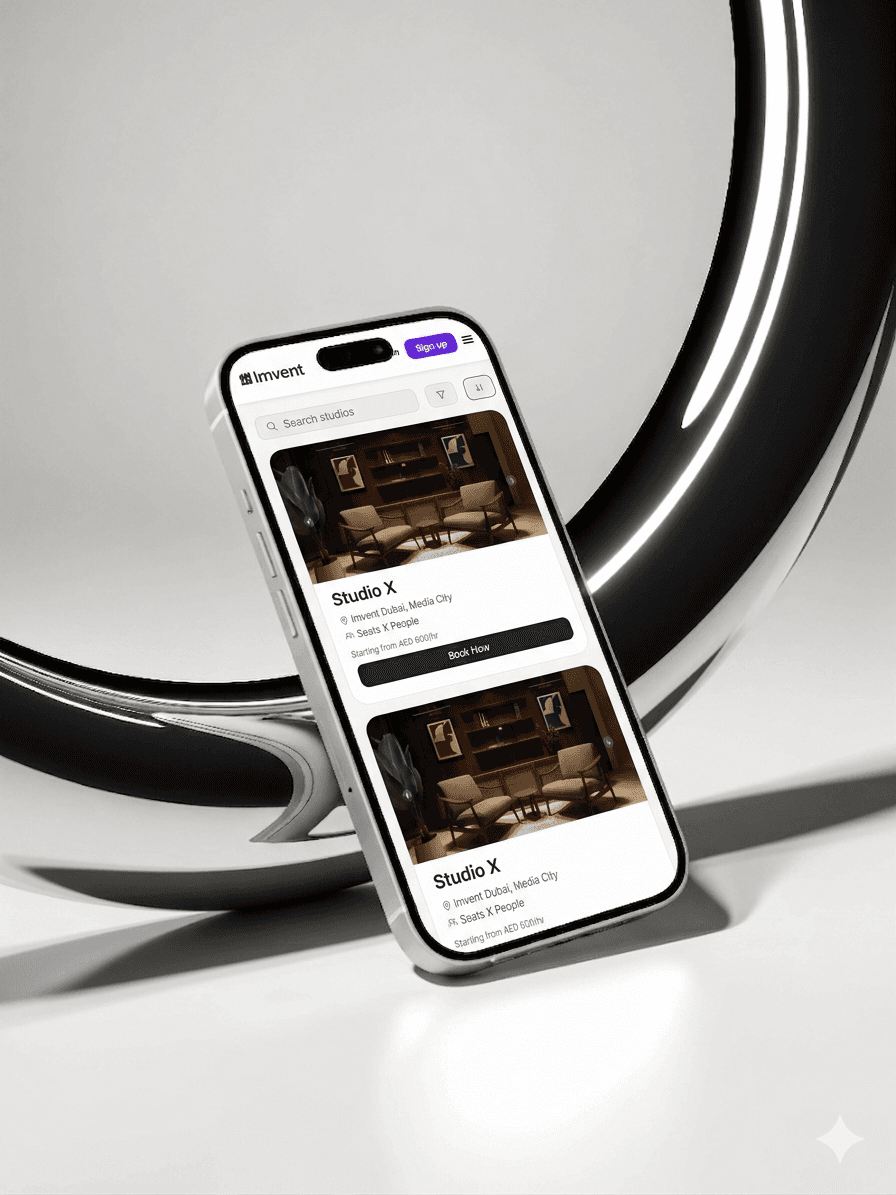
Before a session happens, a creator or brand needs to find the right studio, understand what's included, and feel confident enough to commit. The marketing site was designed to do that work — studio listings with full gear breakdowns, service pages for Content Strategy, Personal Branding, and Videography, subscription and bundle pricing, and featured creator work that built social proof. Each page was structured around the decision-making questions of a specific audience: solo creators evaluating setups, brand teams comparing packages, and agencies looking at roster options.
Surface 2 — Creator Booking Platform
The booking platform was rebuilt around one principle: capture every session detail upfront, so nothing needs to be clarified later.
Creators build a persistent preference profile before their first booking — preferred studio, lighting mood (warm / neutral / cool), framing direction (vertical or horizontal), microphone type, studio temperature, food and drink orders down to milk type and sugar preference, preferred operators by name, and filming time preferences across weekdays and weekends. This profile isn't a settings page — it auto-populates into the operator brief for every future session automatically.
Two booking entry points serve different creator types. Quick Book is for returning creators who know their setup and want to move fast. Studio Browse is for first-time users exploring options by studio name, capacity, and vibe. Both paths follow a consistent 5-step flow: Number of People → Date & Time → Pick a Studio → Service Selection → Add-Ons → Checkout.
Add-ons — refreshments, multi-cam recording, standard cutdowns, extra operator time — are surfaced inside the booking flow, not after confirmation. This single structural change directly addressed the refund disputes the client was tracking.
Surface 3 — Operations Dashboard
The dashboard is what makes the other two surfaces function reliably at scale. It gives managers a single, real-time view of the entire operation — live studio status across all 8 studios, assigned operators per session, next availability windows, and a weekly calendar showing every booking color-coded by studio and status.
Key metrics sit at the top of every session: active subscriptions, total studio bookings, occupancy rate, and total revenue — updated in real time, tracked week over week.
The information architecture was designed to scale. Left navigation covers everything the operations team needs: Studio Bookings, Studios & Setups, All Services, Add-Ons, and Subscriptions & Bundles under Manage; customer records under CRM; Analytics & Reports and API Integrations under Tools; and Global Configurations, Scheduling, Equipment, and Teams & Permissions under Admin Controls.
Managers can now see conflicts before they happen. Operators know exactly what's coming before they open the studio. Agencies can track every creator on their roster from one screen.
Three Surfaces. One Connected Workflow.
The design scope expanded as the problem became clearer. A single screen wasn't going to fix this. The studio needed three interconnected product layers, each designed for a different audience — but all pulling from the same operational state.
Surface 1 — Marketing & Discovery Site
Before a session happens, a creator or brand needs to find the right studio, understand what's included, and feel confident enough to commit. The marketing site was designed to do that work — studio listings with full gear breakdowns, service pages for Content Strategy, Personal Branding, and Videography, subscription and bundle pricing, and featured creator work that built social proof. Each page was structured around the decision-making questions of a specific audience: solo creators evaluating setups, brand teams comparing packages, and agencies looking at roster options.
Surface 2 — Creator Booking Platform
The booking platform was rebuilt around one principle: capture every session detail upfront, so nothing needs to be clarified later.
Creators build a persistent preference profile before their first booking — preferred studio, lighting mood (warm / neutral / cool), framing direction (vertical or horizontal), microphone type, studio temperature, food and drink orders down to milk type and sugar preference, preferred operators by name, and filming time preferences across weekdays and weekends. This profile isn't a settings page — it auto-populates into the operator brief for every future session automatically.
Two booking entry points serve different creator types. Quick Book is for returning creators who know their setup and want to move fast. Studio Browse is for first-time users exploring options by studio name, capacity, and vibe. Both paths follow a consistent 5-step flow: Number of People → Date & Time → Pick a Studio → Service Selection → Add-Ons → Checkout.
Add-ons — refreshments, multi-cam recording, standard cutdowns, extra operator time — are surfaced inside the booking flow, not after confirmation. This single structural change directly addressed the refund disputes the client was tracking.
Surface 3 — Operations Dashboard
The dashboard is what makes the other two surfaces function reliably at scale. It gives managers a single, real-time view of the entire operation — live studio status across all 8 studios, assigned operators per session, next availability windows, and a weekly calendar showing every booking color-coded by studio and status.
Key metrics sit at the top of every session: active subscriptions, total studio bookings, occupancy rate, and total revenue — updated in real time, tracked week over week.
The information architecture was designed to scale. Left navigation covers everything the operations team needs: Studio Bookings, Studios & Setups, All Services, Add-Ons, and Subscriptions & Bundles under Manage; customer records under CRM; Analytics & Reports and API Integrations under Tools; and Global Configurations, Scheduling, Equipment, and Teams & Permissions under Admin Controls.
Managers can now see conflicts before they happen. Operators know exactly what's coming before they open the studio. Agencies can track every creator on their roster from one screen.
Impact
What Changed When the System Went Live
Because every design decision mapped to a documented operational failure, the outcomes were trackable from the first weeks of use.
Pre-session clarification messages dropped significantly. Preference capture at booking replaced the informal WhatsApp coordination that was consuming operator prep time before every session. Operators now open a structured brief — not a chat thread.
Refund disputes tied to add-on visibility decreased. Moving service disclosure into the booking confirmation flow removed the primary trigger for post-session billing conflicts.
Session start delays reduced. Operators arrived to sessions fully prepared — studio temperature, lighting, camera setup, microphone, and even the creator's coffee order — without a single clarification call.
Manager visibility went from zero to real-time. The operations dashboard gave the team its first live view of studio occupancy, operator assignment, and revenue performance across all 8 studios simultaneously.
The platform is now built to support Imvent's expansion across additional UAE locations — the system architecture was designed to scale without structural redesign.
The qualitative shift the client reported: the studio stopped feeling like a series of individual transactions and started functioning like a coordinated operation.
Specific revenue and volume metrics are withheld per client confidentiality agreement.
What Changed When the System Went Live
Because every design decision mapped to a documented operational failure, the outcomes were trackable from the first weeks of use.
Pre-session clarification messages dropped significantly. Preference capture at booking replaced the informal WhatsApp coordination that was consuming operator prep time before every session. Operators now open a structured brief — not a chat thread.
Refund disputes tied to add-on visibility decreased. Moving service disclosure into the booking confirmation flow removed the primary trigger for post-session billing conflicts.
Session start delays reduced. Operators arrived to sessions fully prepared — studio temperature, lighting, camera setup, microphone, and even the creator's coffee order — without a single clarification call.
Manager visibility went from zero to real-time. The operations dashboard gave the team its first live view of studio occupancy, operator assignment, and revenue performance across all 8 studios simultaneously.
The platform is now built to support Imvent's expansion across additional UAE locations — the system architecture was designed to scale without structural redesign.
The qualitative shift the client reported: the studio stopped feeling like a series of individual transactions and started functioning like a coordinated operation.
Specific revenue and volume metrics are withheld per client confidentiality agreement.

Deliverables
Scope of Work
This engagement covered end-to-end UX design across three product surfaces and four distinct user roles.
Marketing & Discovery Site Homepage, studios browse, individual studio detail pages, service pages (Content Strategy, Personal Branding, Videography), subscription and bundle pricing, about, contact, and FAQ.
Creator Booking Platform Two booking entry flows (Quick Book and Studio Browse), 5-step checkout, service selection, add-on browsing with category filters, beverage customization with multiple states, payment flow, and booking confirmation screens.
Creator Preference Profile Persistent session profile covering preferred studio, lighting mood, framing direction, microphone type, studio temperature, food and drink preferences, preferred operators, filming schedule, and communication method preferences.
Operations Dashboard Real-time studio status board, key metrics overview, weekly multi-studio calendar, full left-nav information architecture across Manage / CRM / Tools / Admin Controls, and team and permissions management.
Design artifacts delivered: High-fidelity UI across all three product surfaces · Component system with design tokens · Flow documentation for two booking journeys · Annotated developer handoff documentation.
Scope of Work
This engagement covered end-to-end UX design across three product surfaces and four distinct user roles.
Marketing & Discovery Site Homepage, studios browse, individual studio detail pages, service pages (Content Strategy, Personal Branding, Videography), subscription and bundle pricing, about, contact, and FAQ.
Creator Booking Platform Two booking entry flows (Quick Book and Studio Browse), 5-step checkout, service selection, add-on browsing with category filters, beverage customization with multiple states, payment flow, and booking confirmation screens.
Creator Preference Profile Persistent session profile covering preferred studio, lighting mood, framing direction, microphone type, studio temperature, food and drink preferences, preferred operators, filming schedule, and communication method preferences.
Operations Dashboard Real-time studio status board, key metrics overview, weekly multi-studio calendar, full left-nav information architecture across Manage / CRM / Tools / Admin Controls, and team and permissions management.
Design artifacts delivered: High-fidelity UI across all three product surfaces · Component system with design tokens · Flow documentation for two booking journeys · Annotated developer handoff documentation.
More work
More work
2019 - 2025
2019 - 2025
A showcase of digital products I’ve crafted for SaaS, FinTech, and startup teams.
A showcase of digital products I’ve crafted for SaaS, FinTech, and startup teams.


Contact
Let's Get in Touch
Let's connect and start with your project ASAP.
Or email 2222vishakha@gmail.com
Contact
Let's Get in Touch
Let's connect and start with your project ASAP.
Or email 2222vishakha@gmail.com
Contact
Let's Get in Touch
Let's connect and start with your project ASAP.
Or email 2222vishakha@gmail.com